
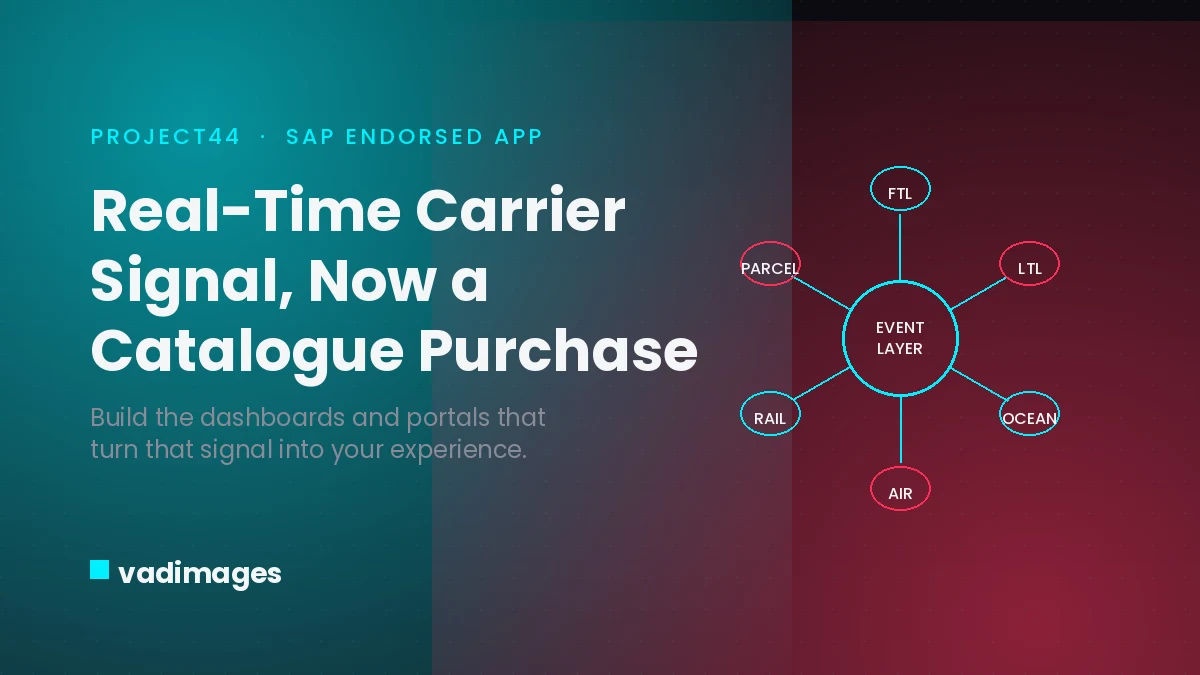
Supply chain visibility used to mean stitching together carrier emails, EDI feeds, and the occasional phone call to a dispatcher. That model is quietly being replaced by certified, packaged data services that drop live shipment signal straight into the systems teams already use. On 16 June 2026, project44 announced that its Real-Time Multi-Modal Visibility Data solution is now an SAP Endorsed App, available for purchase on SAP Store and feeding directly into SAP Business Network for Logistics. For shippers, 3PLs, and brokers, the headline is not the partnership itself — it is what packaged, swappable visibility data means for the web apps and dashboards you build around it.
What project44 actually shipped on 16 June
project44, a three-time SAP Pinnacle Award winner, said its Real-Time Multi-Modal Visibility Data solution reached SAP Endorsed App status — a category of partner solutions that SAP premium-certifies with added security, in-depth testing, and benchmarking. In practice, the app enriches SAP Business Network for Logistics with continuous, real-time carrier signal across every major mode: full truckload, less-than-truckload, ocean, air, rail, drayage, and parcel. That signal includes live positions, predictive ETAs, and port conditions, fed directly into the SAP network so logistics teams can see what is happening to a shipment while it is still in transit.
The scale behind the feed is the point. project44 says the solution draws on more than 259,000 pre-connected carriers across 186 countries and processes over 700 million carrier events every day, with data flowing into SAP Business Network for Logistics immediately when new lanes or carriers are added. The solution is now discoverable and purchasable on SAP Store, the marketplace that hosts more than 2,000 SAP and partner solutions. In short, what was once a heavy integration project is increasingly a catalogue purchase.
Why “endorsed app” and data-as-a-service change the build math
Two shifts matter here for anyone running logistics software. First, visibility data is becoming a productized, certified service rather than a bespoke connection you negotiate and maintain yourself. Second, that service increasingly arrives pre-wired into a platform — in this case SAP Business Network for Logistics — so the raw signal lands in a system of record without a custom pipeline. Both trends are good for teams that want fresher data with less plumbing.
But there is a catch worth naming. When live tracking, ETAs, and exception data live inside one vendor’s platform, the experience your customers and internal teams actually touch — the tracking page, the exception queue, the carrier scorecard — still has to be designed, branded, and wired up. The data being easier to obtain raises the bar on the interface that presents it. And it makes one architectural decision more important than ever: whether your own dashboards treat visibility as a swappable source or hardwire themselves to a single provider.
The integration problem this creates for shippers
Most mid-market shippers and brokers do not run a single source of truth. They have a TMS, maybe an ERP such as SAP, a visibility provider, and a patchwork of carrier APIs and EDI feeds. A packaged endorsed app solves one connection beautifully — the carrier signal into SAP — while leaving the customer-facing and cross-system layers untouched. The practical questions land on whoever owns the web stack:
- How do shippers, customers, and account managers see that ETA and exception data without logging into the platform that stores it?
- What happens when you change visibility providers, add a regional carrier feed, or fall back to direct EDI for a lane the app does not cover?
- How do you reconcile one provider’s event model — positions, predictive ETAs, port conditions — with the milestones your own order and billing systems expect?
- Where do customer-facing tracking pages, branded portals, and mobile notifications come from, if the data only lives inside an internal network?
None of these are answered by buying the data feed. They are answered by the application layer that sits on top of it — and that layer is web and mobile software.
What a swappable visibility layer looks like
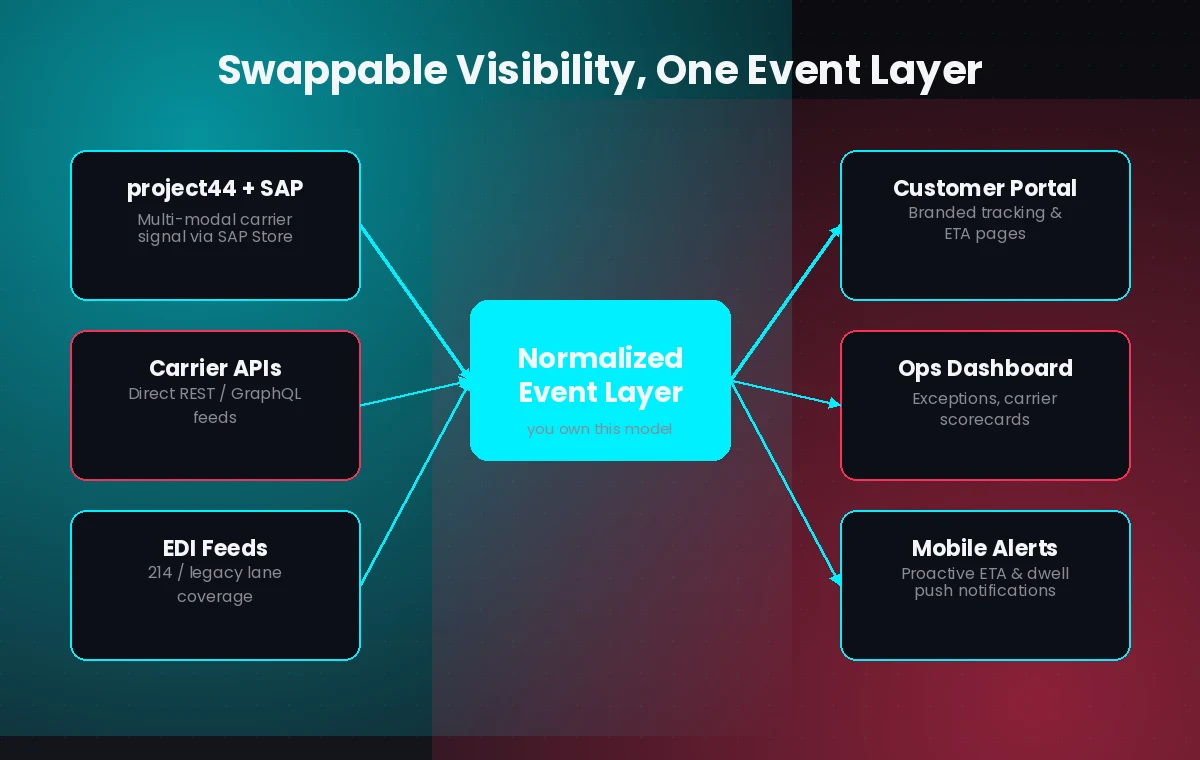
The durable pattern is to treat any visibility provider — project44 through SAP, a direct carrier API, or an EDI feed — as one interchangeable source behind a normalized event stream of your own. Your dashboards, customer portals, and mobile alerts read from that internal model, not directly from a vendor’s payload. Swap or add a provider, and the interface does not change; only the adapter behind it does. That is how you get the benefit of a packaged endorsed app without betting your entire customer experience on one contract.
How Vadimages helps
Vadimages builds the web and mobile software that sits on top of visibility data — we do not sell tracking feeds, telematics hardware, or carrier networks, and we do not operate your TMS or SAP environment. What we build is the application layer that turns a data source like project44’s endorsed app into something your customers and operations teams actually use:
- An integration layer — REST or GraphQL — that ingests carrier signal from project44, SAP Business Network for Logistics, direct carrier APIs, or EDI and normalizes it into one event model you own.
- Customer-facing tracking portals and branded shipment pages that show live positions, predictive ETAs, and exceptions without exposing the underlying platform.
- Internal operations dashboards with exception queues, lane and carrier scorecards, and at-a-glance status across FTL, LTL, ocean, air, rail, drayage, and parcel.
- Native or cross-platform mobile apps that push proactive ETA changes, dwell, and exception alerts to dispatchers, coordinators, and key accounts.
- A provider-agnostic adapter pattern so you can add, swap, or fall back between visibility sources without rebuilding the interface every time a contract changes.
- Reconciliation views that map provider events to the milestones your order, billing, and ERP systems already expect.
The result is a visibility experience that is yours — branded, consistent across web and mobile, and insulated from any single vendor — while the heavy lifting of carrier signal stays with the specialists who do it best.
Bottom line
project44’s move onto SAP Store as an endorsed app is a clear signal that real-time visibility is becoming a packaged, certified service rather than a custom build. That lowers the cost of getting good data, but it raises the importance of the application layer that presents it. Shippers who treat visibility as a swappable source behind their own dashboards and portals will capture the upside of these data services without locking their customer experience to one provider — and that application layer is exactly the web and mobile work we do.