
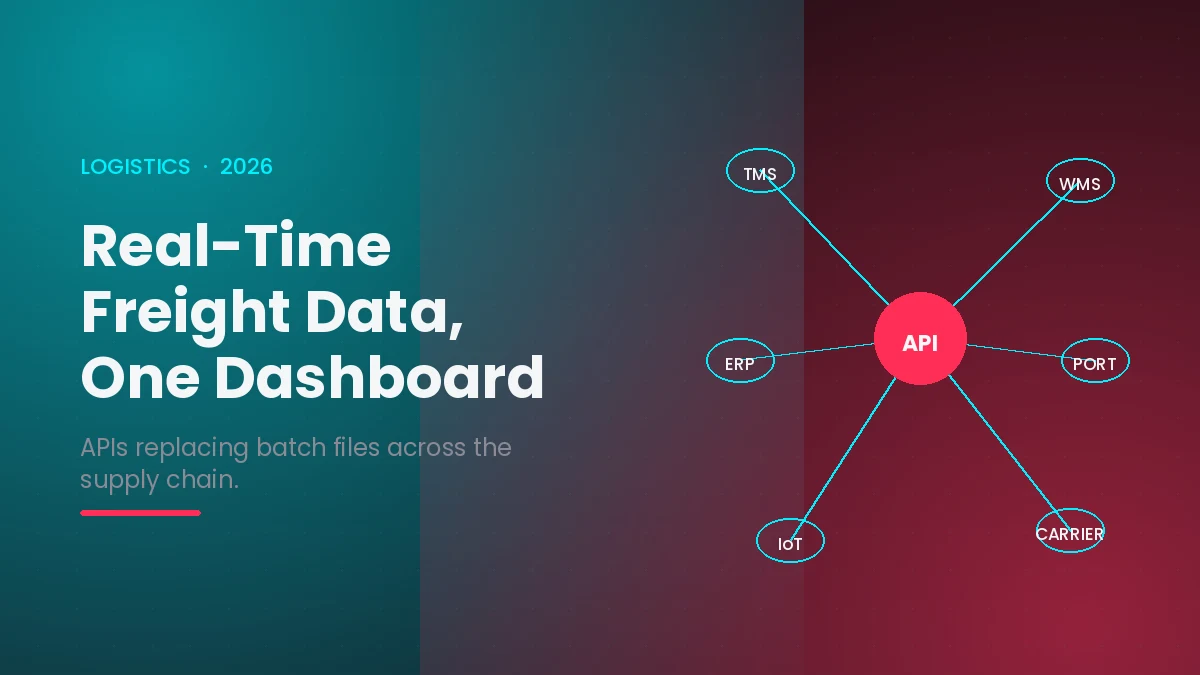
For decades, the data that keeps freight moving traveled on a schedule. Electronic Data Interchange — the batch-file format behind purchase orders, shipment notices, and invoices — was a huge step up from fax and phone, but it was built for a slower world. Files move periodically, not continuously, so a delay that happened at 9 a.m. might not surface in a partner’s system until that night’s batch ran. In 2026 that lag is increasingly incompatible with how supply chains actually operate, and the industry is making a decisive move from batch EDI to real-time, API-based integration. For shippers, carriers, brokers, and 3PLs, the practical question is no longer whether to modernize, but what kind of software to build on top of it.
The shift: from batch files to real-time APIs
As ARC Advisory Group’s Logistics Viewpoints put it in March 2026, supply chain interoperability is entering a new phase: the challenge is no longer simply connecting systems, but enabling intelligent coordination across digital networks that operate in real time. EDI was designed for predictable, periodic workflows. Application Programming Interfaces (APIs) let transportation management systems, warehouse platforms, supplier portals, and visibility networks exchange operational events as they happen — the moment a container is gated out, a truck is delayed, or inventory crosses a threshold.
That change in cadence changes the cadence of decisions. Instead of waiting hours for the next file to land, systems and the people who run them can react immediately. Global Trade Magazine describes the same trend from the operations side: APIs are unifying a freight ecosystem that has always been a complex web of carriers, shippers, customs brokers, and warehouse operators, eliminating manual re-keying and letting shipment status, container tracking, and documentation flow across the chain in real time.
Why this matters for logistics operators
The payoff of real-time integration is not abstract. It shows up in the daily work of dispatchers, customer-service teams, and operations managers who currently stitch together updates by hand.
- Faster exception management: when weather, port congestion, or an equipment failure disrupts a shipment, teams see it as it happens and can reroute or re-plan rather than discovering it the next morning.
- Fewer manual touches: order booking, status updates, and invoicing can be exchanged system-to-system instead of by email and phone, freeing staff for higher-value work.
- Better customer experience: shippers and end customers increasingly expect self-serve, parcel-grade tracking for freight, not a phone call for an ETA.
- A foundation for AI: the autonomous orchestration everyone is talking about — software that detects a delay and recommends a reroute — depends entirely on continuous, reliable data across platforms. Without clean real-time feeds, there is nothing for AI to reason over.
What a unified logistics view looks like
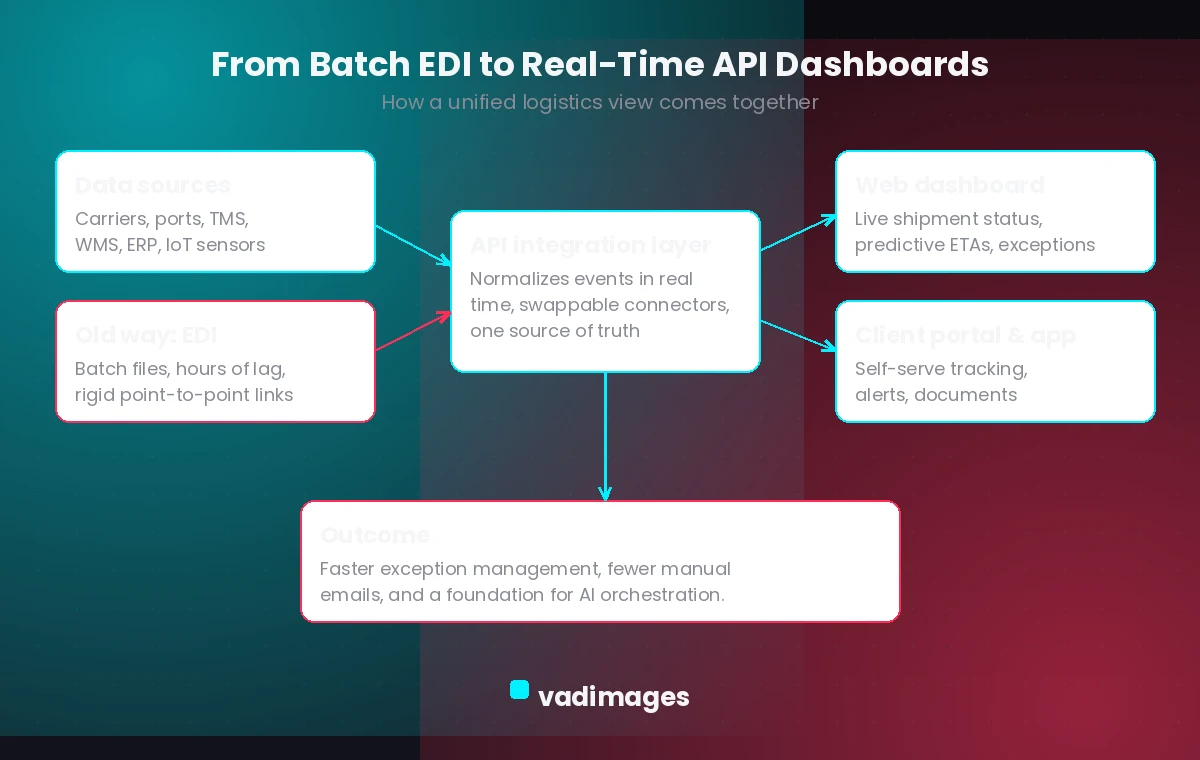
The destination most operators are working toward is a single operational view rather than a pile of disconnected logins. Data from carriers, ports, TMS, WMS, ERP, and IoT sensors flows through an integration layer that normalizes events in real time, then surfaces in two places people actually use: an internal web dashboard for the operations team and a customer-facing portal or mobile app for shippers and consignees. The integration layer matters as much as the screens, because data sources in logistics change constantly — carriers are added, a visibility provider is swapped, a port upgrades its API. A well-designed layer treats each source as a connector that can be replaced without rebuilding the whole system.
The catch: integration is the hard part
Moving off batch EDI is rarely a clean switch. Many partners still send EDI, others expose modern REST or GraphQL APIs, and a few offer only spreadsheets or webhooks. Real-time data is also messier than nightly files: duplicate events, out-of-order updates, and brief outages are normal, so the software has to reconcile and de-duplicate rather than trust every message. And the more a business runs on live data, the more a clear, fast, reliable interface becomes the product. The technology shift is real, but the value is captured in the application layer — the dashboards, portals, and integrations that turn a firehose of events into decisions.
How Vadimages helps
Vadimages is a web and mobile app development studio, and this is squarely the kind of build we do. We don’t sell telematics hardware, ELDs, or a freight network — we build the software that sits on top of the data sources you already use and the ones you’ll add next.
- Operations dashboards: real-time web dashboards that consolidate shipment status, predictive ETAs, and exceptions into one screen, with filtering, search, and role-based access for dispatch and customer-service teams.
- Customer portals and mobile apps: self-serve tracking, proactive alerts, and document access for your shippers and consignees, on web and on native or cross-platform mobile.
- Integration layers: a connector-based architecture that ingests events from carriers, TMS, WMS, ERP, and visibility providers over REST, GraphQL, webhooks, or existing EDI feeds — with normalization, de-duplication, and swappable data sources so you are never locked to one provider.
- Internal web tools: booking, billing, and reconciliation interfaces that replace email-and-spreadsheet workflows with software your team actually wants to use.
Because we build the application and integration layer rather than operate your logistics network, you keep full control of your carriers and systems while getting a clean, modern surface on top — and a codebase that is ready for AI-driven features when you are.
Bottom line
The move from batch EDI to real-time APIs is one of the most consequential shifts in logistics technology right now, and it rewards operators who can turn live data into clear decisions. The data plumbing is becoming standard; the competitive edge is in the dashboards, portals, and integrations built on top of it. If you’re planning that build, Vadimages can help you design and ship it.